All You Need To Know About E-Way Bills
Under GST, transporters may have eWay bills while shipping goods in other circumstances. Read on to find out more on e-way bills.
free GST software*Free & Easy – no hidden fees.

Under GST, transporters may have eWay bills while shipping goods in other circumstances. Read on to find out more on e-way bills.
free GST software*Free & Easy – no hidden fees.
Looking for Free GST Billing Software? See Plans and Pricing
A1. A GST E-way bill is more commonly referred to as a Goods & Service Tax based Electronic Way Bill. It is a unique invoice / document / bill that is specifically formulated and created for the transfer of products / goods via a labeled consignment from one destination to another. These locations of transfer can either be within specific states or within a route that includes crossing one or several states. Also, another factor that the leaders of the GST regime have thrown in is the overall financial value of the goods to be transferred or moved. If the total price exceeds Rs. 50,000, then they are liable to contribute to the GST E-way bill.
Back in the day, coordinators of these consignments had to generate a physical document known as the ‘Way Bill’ which would allow the transfer of goods under a specific VAT (Value Added Tax) bracket. But now, this ‘Way Bill’ has been replaced by an “E-Way Bill” under the GST rule. Since the 1st of April, 2018, all consignments whether interstate or intrastate have to pay a compulsory and unavoidable amount that the E-way bill states. Keep in mind that the GST E-way bill is a mandatory document that is given through a common GST portal that undertakes and supervises the movement of goods within a country.
A2. The GST focused E-way bill has been made applicable for all consignments that carry goods over the price of Rs. 50,000 within a specific state or amongst several states. Since the 1st of April, 2018 the E-way bill has been made compulsory. This was done to ensure that the illegal transfer of goods across different locations would be put to a standstill. In the event, the shipping of goods occurred for a distance of more than 10 km but less than 50 km, the person responsible for the package has to clear the amount specified by the government generated E-bill. Keep in mind this E-way bill has to be generated online, thus the terminology “E”-way bill, as the ‘E’ refers to ‘Electronically’. Irrespective of the city, state and union territory, the GST bill is applicable to all locations.
A3. Irrespective of whether the transfer or shipping of a consignment takes place on an interstate or intrastate route, the E-way bill has to be generated before the transfer or commencement of goods takes place. However, there is some form of relief for manufacturers and businessmen who are not required to contribute to the GST E-way bill. If the total value of the shipment sums up to less than Rs. 50,000 then they are exempted from this rule and are free to go about their business, whether it is inter-city, inter-state or intra-state. However, if an individual or the collective shipment is required to pay the GST E-way bill, they must be aware whether the bill is generated by a registered or unregistered individual, as the process for each of these routes varies. A registered person is required to fill out form GST EWB 01, whereas, an unregistered individual is required to fill out a different version of the similar form known as GST EQB 01.
Another criteria for the generation of an E-way bill is with regard to a vehicle transporting / shipping goods that come with multiple invoices. As long as the total value of these combined invoices exceeds Rs. 50,000, a GST E-way bill is a mandatory requirement.
A4. The whole point of a GST focussed E-way bill is to charge organizations and businesses for the transportation of shipments. These shipments whether being moved within a single state or amongst several states are liable to the payment of such charges. How long would the E-way bill be valid from the moment it has been generated can be a constant question in the minds of consignment coordinators and packer & mover business owners. This answer can change based on the distance that the vehicle transporting the goods is needed to travel. Generally, an E-way bill is valid for 24 hours – i.e – one day, from the moment it was created. Also, a limitation for this 24-hour validity depends on the distance traveled. This limitation stands for every 100 km traveled.
Basically, if a vehicle that transports goods travels 100 km or less, then the first generated bill is valid for an overall time period of 24 hours. But for any additional kilometers traveled over 100 km, a new GST E-way bill has to be generated. Also keep in mind that regardless of what time of a day the E-way bill was generated, by 12 AM of the following day the E-way bill expires. Depending on the type of products being transported, the GST commissioner can apply for an extension. In case the commissioner cannot extend the E-way due to unavailability or other issues, the transporter responsible has to generate another E-way bill by updating information on part B of the GST EWB 01 form.
There is also an expiry period for applying for an extension. Only within 8 hours before and after the current E-way bill expires can another E-way bill be extended. If this time period is missed due to some circumstances, then the only other option is generating a new E-way bill with the apt details.
A5. As an E-way bill is a mandatory requirement for a particular filtered section of all transportation and shipping consignments, there is a legal process that must be followed to ensure point-on abiding of the E-way bill generation pipeline. There are two categories of individuals who generally take care of the generation process of an E-way bill. Keep reading to have a better idea of these categories.
1. Registered Individuals – As long as a person is involved in any part of the pipeline that describes being related to the consignment, he is considered a registered individual. Whether the person is a part of the sales, branch transfer, legal paperwork or project management of the consignment assignment, they are categorized as a registered individual. If the registered person is involved in the movement of goods as a consignor or as a buyer, either in their own conveyance or via a 3rd party railway, air or sea vessel, the person would have to fill out a form called GST EWB 01, online on the common GST E-way bill portal. Although, prior to doing the above step, they first have to furnish all information present on part B of the form.
Documents such as the Supply Bill, Transporter ID, Vehicle Number and document number of transport need to be submitted by the registered individual. But if the transport process has been initiated by the registered individual and handed over to the transporter responsible for transportation by road, situations can arise when the E-way bill was not generated by the registered person. As records will indicate that a registered person was involved in the process, the transporter would now be responsible to generate the E-way Bill. As long as the registered person has furnished and double-checked all details of the transporter in part B of form GST EWB 01 on a website called gst.gov.in. the transporter can submit the form by filling part A of the same.
2. Unregistered Individuals – If an unregistered person is left responsible to generate the E-way bill, then the person itself or the transporter will have to handle the E-way bill generation process. If an unregistered person supplies goods to a registered person and the identity of the latter is known while commencing the movement of goods, then it would be recorded as “the goods have been moved by the registered person”.
If none of the two parties have generated an E-way bill and the total value of the consignment exceeds Rs. 50,000, then it is left in the hands of the consignment transporter to generate and complete form GST EWB 01 via taking information from the original invoice of the consignment. If the transporter is generating an E-way bill during the transfer of goods then the details of conveyance have to be filled on the E-way bill by accessing a website known as gst.gov.in.
If multiple consignments are being transported with the help of a single vehicle, then the serial number of each E-way bill in accordance with the respective consignment must be consolidated in form GST EWB 02 and must be generated prior to the movement of goods.
A6. As an E-way bill is an Electronically generated bill, it can and must only be done online via accessing the internet. An individual or an organization that has been registered under the GST tax law will have to refrain from transporting goods over a total of Rs. 50,000 if they have not generated an E-way bill on ewaybillgst.gov.in. There are different routes that can be taken to generate an E-way bill. Such as, via the E-way bill Android Application, SMS or via website registration using API (you do not need to get into the specifics of API, so do not worry). Once the E-way bill has been generated, a unique E-way Bill Number (EBN) is assigned to the supplier, transporter, and receiver as a whole. Few prerequisites to remember before attempting to generate an E-way bill are as follows
The following are the steps for a hassle-free E-way bill generation process –
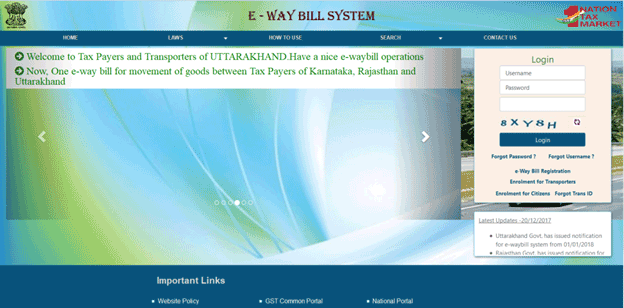
Step 1 - Open the E-way bill system or portal via the World Wide Web and click on login. Once you click on login, answer the username of password prompts. Also, ensure you insert the correct Captcha code as you will not be allowed to login if this is not accurate. The Captcha code is for added security purposes.
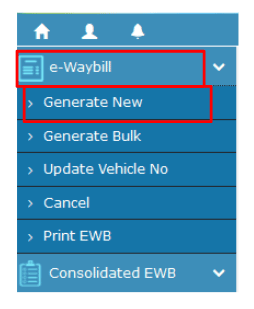
Step 2 - Under the E-way Bill tab, click on Generate New. Once you do the same, you will see multiple fields on the screen. Carefully understand each question and its options before choosing, otherwise, you will have to generate a new E-way bill and have existing records of your faulty E-way bill.
Step 3 -The first field for you to select would be ‘Transaction type’.

Up next comes the subtype field. Make sure to select the most relevant type of E-way bill you are attempting to generate. Depending on what transaction type you chose, different options will appear.
If you are the supplier or provider of a consignment then click on ‘Outward’.

But if you are the receiver of a consignment then click on ‘Inward’.

Step 4 -This is when you have to specify the type of document you are submitting as proof of consignment contents and total value. You will see options ranging from Challan, Credit Note, Invoice, Bill of Supply and others. Choose the relevant document and if you land up choosing ‘Others’, in the empty field you must specify the name of the document you are submitting.
Step 5 -Enter the correct invoice number or document number, followed by the date of the invoice or whatever option you chose in Step 4. Keep in mind that future dates will not be taken as an input by the system.
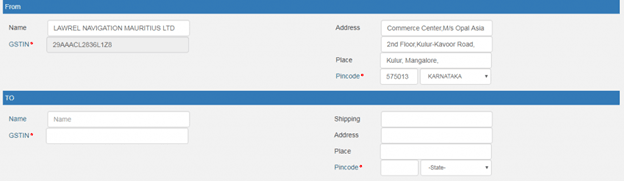
Step 6 -This section requires you to populate the address section entirely. This includes the pin code, state, city and full precise address of the final location. There will be two options to choose from, either ‘From’ or ‘To’. These options are for whether you are a supplier or recipient respectively. In the event, the supplier has not been registered then mention ‘URP’ in the GSTIN field. This means the supplier is an ‘Unregistered Person’.
Step 7 -A prompt will appear asking for all specifics regarding the goods being transported. Fields such as product description and name, quantity of goods, number of units, overall value and taxable value, CGST and SGST tax rates, and HSN will need to be accurately filled.

Step 8 -Details of the transporter responsible need to be filled in this step. Mandatory fields would be the mode of transport and approximate distance to be covered. Apart from these two fields, either the transporter Id, transporter document number or the vehicle number needs to be filled.
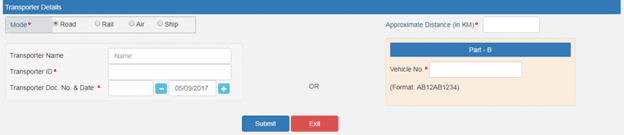
Note – If you regularly generate such GST E-way bills then head to the ‘My masters’ section on the dashboard and update your records there.
Step 9 -After correctly filling out all information demanded from Step 1 to Step 8, you can reverify the details and then click on Submit. If any errors are found then the system shall show them in red color. If everything seems fine and fits perfectly then form EWB 01 successfully generates an E-way bill along with a unique 12-digit code and a barcode.
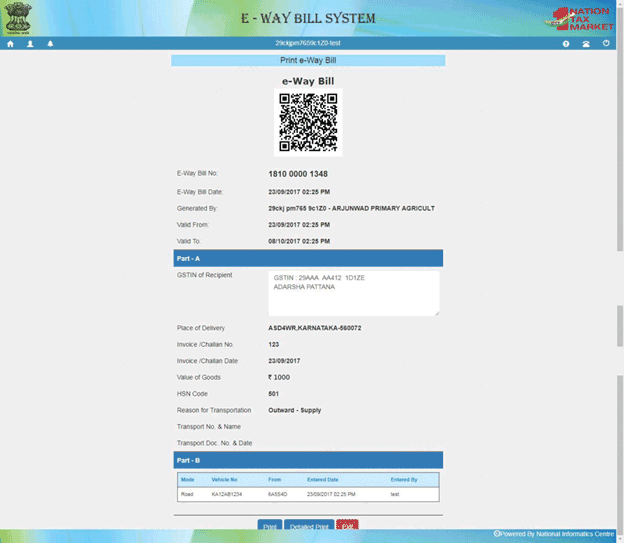
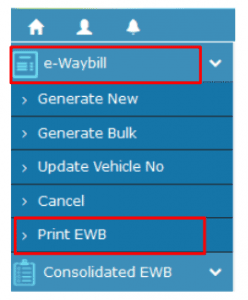
Step 10 -Head to the E-way tab on the top left corner and click on the drop-down menu. A ‘Print EWB’ option will exist. Click on it and enter the 12-digit code generated in Step 9.

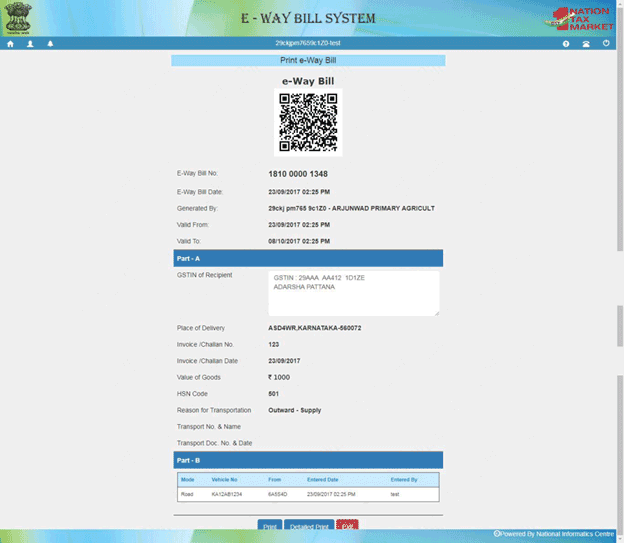
Finally, you click on ‘Print’ or ‘Detailed Print’ and you have succeeded in acquiring a legally approved GST E-way bill.
A7. Usually, the GST E-way bill norm follows a process that requires a transporter or business to tick mark 2 criteria that finalizes whether or not they require an E-way bill. The total value of the goods being transported must be over Rs. 50,000 and the goods that are being transported are for a distance of over 10 km. In the event that the overall value of the goods being transported is less than Rs. 50,000 there are a few cases where the E-way bill can be an optional choice. If the goods comprise of Handicraft products and inter-state government projects then E-way bills are needed for goods that sum up to less than Rs. 50,000.
Apart from this, generating a GST E-way bill for the total value of goods being below Rs. 50,000 is an optional decision. Some individuals and organizations make the generation of an E-way bill a part of their transportation pipeline, irrespective of the total value of the goods being transported. Also, if consignments that have an overall financial value of under Rs. 50,000 are being transported under any of the following situations, an optional E-way bill will not even be accepted –
A8. Generating an E-way bill for single consignments is a mandatory and simple procedure that has been explained in detail above. But what must one do in a situation when several consignments are being transported across or within states using just one vehicle? This situation calls for a consolidated E-way bill that consists of individual 12-digit serial numbers of all E-way bills within one big consignment. A form known as GST EWB 02 must be updated with this collective information generated before the movement of goods takes place. This is a more efficient and convenient solution as compared to carrying multiple E-way bills for multiple consignments in one conveyance (goods vehicle).
Keep in mind that multiple invoices cannot be clubbed to generate a single E-way bill, but only after generating a single E-way bill for each invoice can you prepare a consolidated E-way bill for transportation purposes.
A9. Situations can arise where goods are required to be transferred from one vehicle to another amidst the transportation process. This can happen due to reasons such as vehicle compatibility with the type of road, vehicle malfunctions, miscalculations regarding vehicle capacity or overall load of the goods and improper vehicle registration. In such events in order to maintain a smooth flow of events, the transporter must immediately generate a new E-way bill by filling out form GST EWB 01 by inserting the correct details of the mode of transport. These correct details would consist of the information regarding the new mode of transport and can be only filled on the common online GST portal.
However, if the total distance of transfer of goods between the starting destination, transporter’s destination and consignment arrival destination is under 10 km then it is not required to update the GST EWB 01 form with details of the new vehicle the goods may have been transferred to.
A1. You may find yourself in a situation where the E-way bill was successfully generated and printed on time, but the transportation of goods never took place. There is a very tight time frame to cancel this E-way bill. If the E-way bill is not canceled within a period of 24 hours (1 day), from the time of its generation, then the system by no means will permit you to make any changes, file a complaint or cancel the existing E-way bill. Also, keep in mind that there is no specific location or office where one must visit to cancel an E-way bill.
As the term suggests ‘E’-way bill, it must be canceled electronically on the GST based E-way bill portal, via the internet, just as it was generated. In case the goods are not being transported, then make sure to cancel the E-way bill before the officer has verified it during or pre-transit.
A2. There are unfortunate situations that can arise such as the expiry of the validity period of an E-way bill while the consignment is in transit or just about to begin the transfer. The transportation may not be complete due to unforeseen reasons such as vehicle breakdown, unexpected weather, driver falling ill or a hurdle due to landslides and broken roads. Usually, in such a situation, the consignment has to come to a standstill until and unless the GST E-way billing committee is not informed of the same and a solution is derived.
Under this specific circumstance, as the consigner will not be available during transit, the transporter can extend the validity period by how much every time he finds necessary. In order to extend this validity, Part B of the form GST EWB – 01 has to be updated with the precise reason for the extension. The usual validity of an E-way bill is 24 hours for a distance of 100 km. If the distance is not covered in 24 hours then another E-way bill is required to be generated. This hassle is adjusted by simply updating part B of the form as and when situations that cause delay come up.
To Download GST software online visit www.freebillingsoftware.com

The coronavirus pandemic has, in many ways, altered the normal flow of human
Read more
Billing is a major challenge for SaaS business owners these days.
Read more
The civilisation is at that stage where machines control everything.
Read more
Small business enterprises usually manage things on a spreadsheet.
Read more
In today’s age and times, when more and more youths are attracted.
Read morePlease let us know how we can improve Fortune Billing Software so it suits you best.